Creative Process, Illustration, Visual Storytelling
Two great stories collided in my dream and I woke up wanting to draw.
I fell asleep thinking of Philip K. Dick's story and woke up inside Saint-Exupéry's world. Well, kind of, at least, as the boundaries were a bit blurry.
It happens to me pretty often. Two unrelated stories find each other in the dark, and by morning they've turned into something new, something neither author wrote, something that didn't exist until my sleeping brain decided it should.
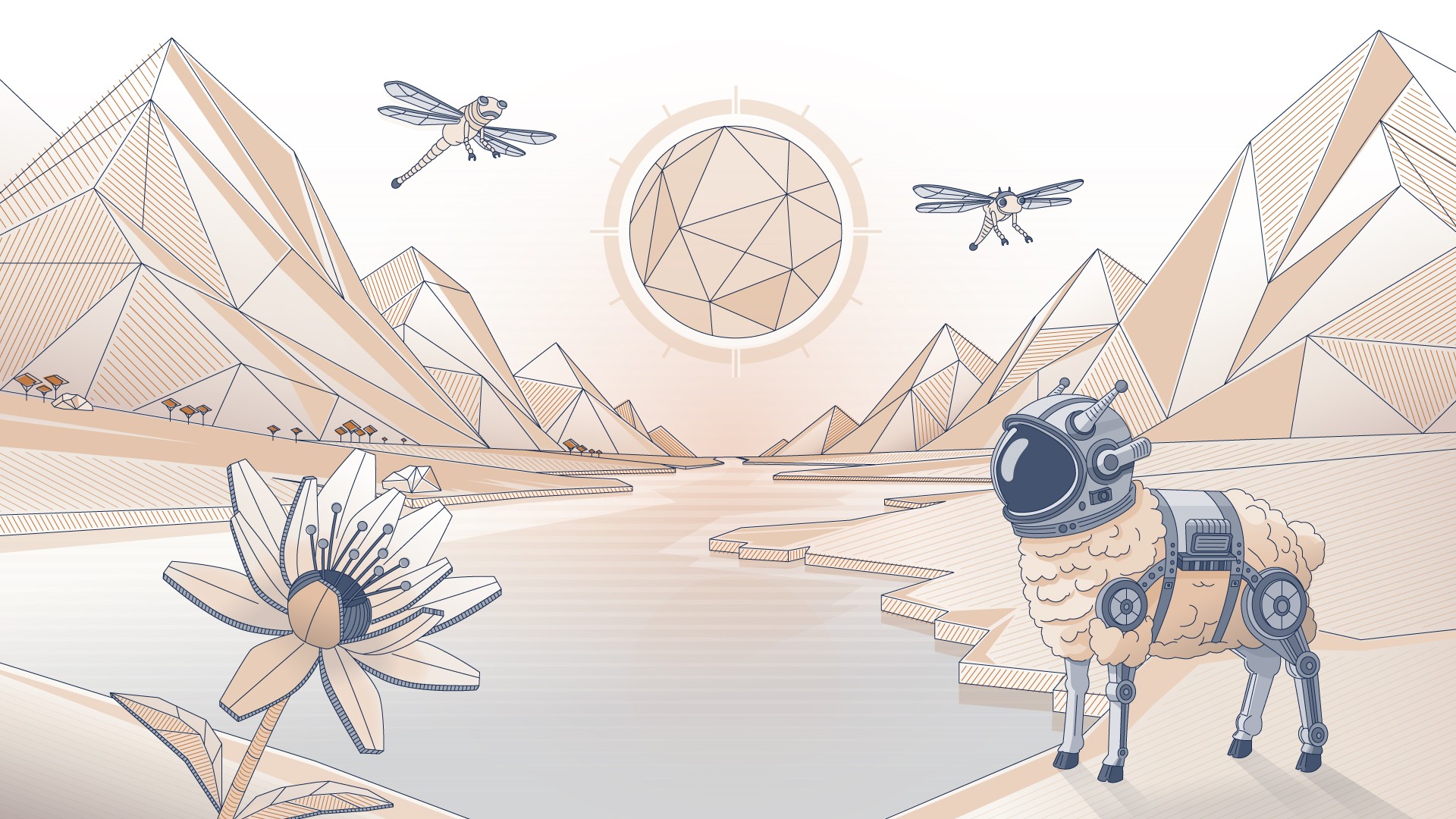
There was a mechanical sheep. Wool gently hugging the gears, metallic articulations where joints should be, an astronaut's helmet over its head as if someone had worried it might need to breathe on a planet with no air. It was standing at the edge of a river that moved in sharp angles, looking out across a landscape made entirely of folded geometry. Origami mountains were guarding a shy polygonal sun, while two semi-robot dragonflies scouted the surroundings.
On the opposite side of the river was the flower. Copper and white with a navy blue heart. Not eaten. Not yet.
If you've read The Little Prince, you know why the flower matters: "Look up at the sky," says the story. "Ask yourself: has the sheep eaten the flower or not? And you'll see how everything changes."
At the end, the weight of the narrative rests on a question no one can answer. A sheep, a flower, and the not-knowing. And the fact that the not-knowing is what makes you look up.
Dick was circling the same question, just from the other side. He spent an entire novel questioning whether what we care about matters and if care is less real when its object is artificial. Does empathy have a minimum biological requirement? Does the difference between a living thing and a copy of it count?
In my dream, the questions and concepts blended.
What would happen if an electric sheep ate a flower whose only importance is that someone decided it was important? Can a mechanical brain destroy something whose entire value is emotional? Can a thing built from gears grieve a flower it was never taught to love?
I opened my eyes, and the image was still there. The geometric mountains. The copper light. The sheep with its helmet and its gears, standing still, looking at the flower across the water.
So I drew it.
I drew it in the only palette that made sense, the minimal range I've built my visual identity around. Warm white for the environment, copper for everything that carries feeling, and navy for the mechanical parts, the engineered joints, the precision underneath. The restriction turned out to be the point. When you can't reach for more colors (or options), the outcome matters more. The copper isn't warm by accident. And the navy isn't cold because I decided so. The tension between them is the tension between the two stories.
The style landed somewhere between nature origami and steampunk with folded pixels and cold fittings – tenderness and machinery, occupying the same body.
I keep coming back to the sheep's helmet.
It wasn't in either book. My dream added it. And I think I know why. The Little Prince travels between planets, while Dick's characters live in a world where the sky is always wrong – polluted, emptied, a constant reminder of what's been lost. The helmet lets the sheep exist in both worlds.
Maybe this is what Saint-Exupéry was really asking? Not whether the sheep ate the flower, but if we still look up. Whether we let a question with no answer change how we see everything. Whether we've become the kind of grown-up who counts stars instead of wondering at them.
The electric sheep looks up. Mechanical eyes behind curved glass, scanning a geometric sky for a faceted sun. It doesn't know if the flower matters. It looks anyway.
I think that's the whole dream, really.
Two stories about looking at things and deciding they matter. One asks whether the thing has to be real. The other asks whether the looking has to have a reason.
The answer to both, I suspect, is no.